Product Overview
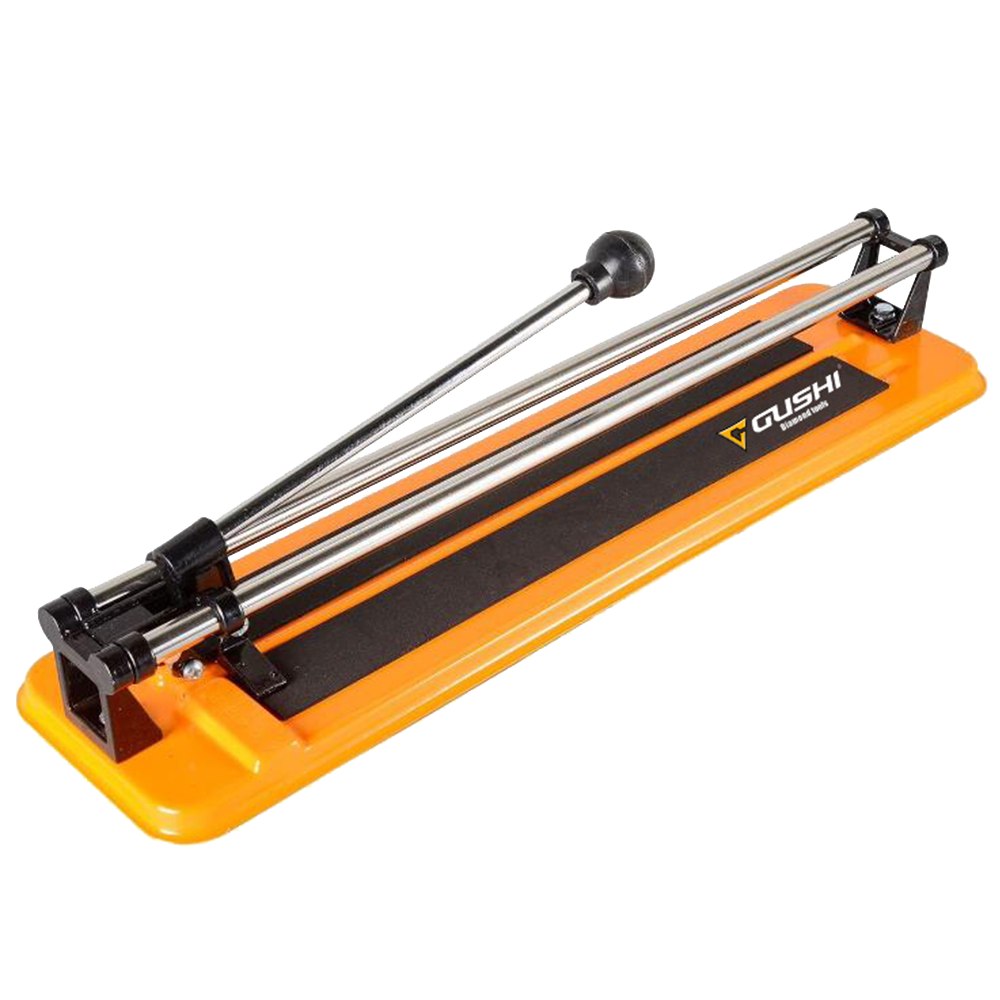
The GUSHI Standard Manual Tile Cutter is a score-and-snap cutter for ceramic and porcelain tiles up to 14 mm thick, offered in 600, 800 and 900 mm cutting lengths with diagonal capacities of 425, 565 and 635 mm. An aluminum base plate and double chrome-plated solid rails keep the frame from bending during the break, while a tungsten carbide wheel scores the glaze in one pass and an 800 kg breaker separates the tile cleanly, with straight-cut accuracy within 1.5 mm. An anti-slip rubber handle with an anti-pinch device and a wide steel base on an anti-skid mat make it stable and safe to use. It needs no power and no water. It is built by Huzhou Gu’s Imp. & Exp. Co., Ltd., a Zhejiang manufacturer founded in 2004 that is ISO 9001:2015 and CE certified, inspects 100% before shipment and exports to more than 20 countries.
This is the model for people who tile occasionally rather than every day: homeowners doing a bathroom, landlords turning over a flat, maintenance teams and small renovation crews. It does the same two things a professional cutter does — score straight, snap clean — at a price and weight that make sense when the tool spends most of its life in a cupboard or a van.
It is deliberately positioned below the GUSHI High-Grade Manual Tile Cutter. That model adds a 1200 mm length, 18 mm thickness capacity, a 1000 kg breaker and accuracy within 1.0 mm for crews working daily on large-format material. Everything else — base design, double solid rails, anti-pinch handle, replaceable carbide wheel — is shared, so spare parts and technique carry over between the two.
Full Specifications
| Parameter | Specification |
|---|---|
| Product name | GUSHI Standard Manual Tile Cutter |
| Series | GTC-S — 600 / 800 / 900 mm |
| Cutting method | Score and snap — fully mechanical |
| Cutting length — GTC-S600 | 600 mm (diagonal 425 mm) |
| Cutting length — GTC-S800 | 800 mm (diagonal 565 mm) |
| Cutting length — GTC-S900 | 900 mm (diagonal 635 mm) |
| Cutting thickness | 4–14 mm |
| Scoring wheel | Tungsten carbide, Ø22 × 6 × 6 mm, replaceable |
| Wheel life | ≈800–1,500 m on ceramic; 300–600 m on porcelain |
| Breaking force | 800 kg (≈7.8 kN) |
| Straight-cut accuracy | Within 1.5 mm over the full length |
| Cut types | Straight rip cut, 45° diagonal cut, repeat cuts |
| Base plate material | Aluminum alloy plate with wide steel foot |
| Guide rails | Double chrome-plated solid steel rails, Ø18 mm |
| Sliding system | Bearing slider for smooth, play-free travel |
| Handle | Anti-slip rubber grip with anti-pinch device |
| Base stability | Anti-skid rubber mat on the steel foot |
| Angle guide | Aluminium T-square with 45° scale |
| Side supports | Removable supports for larger tiles (800/900 models) |
| Net weight — GTC-S600 | ≈9 kg |
| Net weight — GTC-S800 | ≈11 kg |
| Net weight — GTC-S900 | ≈13 kg |
| Product size (GTC-S800) | ≈1060 × 220 × 240 mm |
| Packing | 1 pc carton; 2 pcs/outer carton (600 and 800 models) |
| Power requirement | None — dry cutting, no water needed |
| Certifications | ISO 9001:2015, CE, RoHS-compliant materials, SGS inspected |
| MOQ | 100 units (mixed cutting lengths in one order) |
| Lead time | 5–10 days standard; 15–30 days OEM |
| Payment terms | T/T, L/C, D/A, D/P, PayPal |
How the Standard Cutter Works
Scoring creates a weak line, not a cut
The tungsten carbide wheel is many times harder than the glaze. Pressed along the surface under hand pressure, it crushes a narrow groove about 0.2–0.4 mm deep. That groove concentrates stress at one line so the tile separates predictably instead of cracking at random. The wheel never cuts through — it only decides where the break will run.
Snapping with 800 kg on a line
The breaker foot presses down a few millimetres either side of the score while the tile rests on the base, applying roughly 800 kg across a narrow region. That turns the shallow groove into a through-crack in a fraction of a second. Because the force is controlled and focused, the result is a straight edge rather than a shattered tile — provided the groove was clean and the frame did not flex.
Why the base and rails decide the result
Any movement between scoring and snapping shows up as a stepped or angled break. The aluminum base plate and the pair of chrome-plated solid rails work as one stiff beam so the carriage cannot tilt as it crosses the tile, and the anti-skid mat stops the whole machine shifting on an uneven floor. On a light machine especially, this rigidity is what makes a 1.5 mm tolerance achievable rather than theoretical.
Diagonal and repeat cuts
Diagonal capacity follows the geometry of a square — cutting length × 0.707 — so the 900 mm model cuts 635 mm at 45°. The aluminium T-square locks at a true 45° for corners, and the side stop lets you run a batch of identical rip cuts without re-measuring, which is what makes a border or a run of plank tiles practical rather than tedious.
Key Features Explained
Heavy-duty construction at a lighter weight
The aluminum base plate and double solid rails give the machine the stiffness it needs to break tile accurately, while keeping the 600 mm model down to about 9 kg. That balance matters when the tool has to be carried up stairs or lifted in and out of a car rather than living on a site.
Ergonomic handle with anti-pinch device
The anti-slip rubber grip gives control over scoring pressure, which is the variable that decides whether a tile snaps cleanly or chips. The anti-pinch guard keeps fingers clear of the rail and breaker during the snap — a detail that matters most on a tool used by occasional users rather than by people who do it every day.
Wide steel base with anti-skid mat
A wide, thick steel foot spreads the load and keeps the machine planted, while the rubber mat stops it sliding mid-score. A machine that shifts while scoring produces an off-line groove, and no amount of force on the breaker will correct that afterwards.
Replaceable carbide wheel and shared spares
The 22 × 6 × 6 mm wheel is the same consumable used across the GUSHI cutter range and swaps in under a minute. Sharing spares with the High-grade model means distributors stock one part number and users can find replacements anywhere in the range.
Dry, quiet and power-free
With no motor, pump or water tray, the cutter works anywhere — in a finished bathroom, on a balcony, or on a job where the power is not connected yet. There is no slurry to contain and no wet dust to clean up, which is why manual cutters remain the default choice for renovation work indoors.
Selection Guide: Standard or High-Grade?
Both machines cut the same way. The question is how often, how thick and how big.
| Your situation | Recommended model | Why |
|---|---|---|
| Occasional DIY: one bathroom or splashback | ✓ Standard 600 | Lightest and cheapest; handles 8–10 mm wall tile easily |
| Landlord or maintenance work, a few jobs a month | ✓ Standard 800 | Covers 600 and 750 mm floor formats at the lowest cost |
| Standard 800 × 800 floors up to 12 mm | Standard 900 | Extra length costs little and avoids limits later |
| Tiling most working days | High-Grade 1000/1200 | 1000 kg breaker and heavier rails survive daily use |
| Tile thicker than 14 mm, or longer than 900 mm | High-Grade 1200 | Handles up to 18 mm and 1200 mm lengths |
| Notches, L-shapes, curves or holes | Wet saw or diamond core bit | No snap cutter does these cleanly |
| Tile type | Thickness | Standard model suitable? |
|---|---|---|
| Glazed ceramic wall tile | 6–10 mm | Yes — ideal |
| Glazed ceramic floor tile | 8–12 mm | Yes |
| Porcelain floor tile | 10–14 mm | Yes, with a sharp wheel and one-pass scoring |
| Thick porcelain / 20 mm paving | 18–20 mm | No — use the High-Grade model |
| Glass mosaic and small glass tile | 4–8 mm | Yes, score gently |
| Natural stone slabs | 20 mm+ | No — use a wet saw |
Applications & Suitable Materials
Applications
| Application | Why the Standard model fits | Recommended size |
|---|---|---|
| Bathroom and en-suite renovation | Dry, quiet cutting in finished rooms; no water to carry | 600 mm |
| Kitchen splashbacks | Clean edges around sockets; light enough to set up on a counter | 600 mm |
| Rental property refurbishment | Cheap enough to keep on the van for occasional jobs | 800 mm |
| Residential floor tiling | Handles 600–800 mm formats with repeat rip cuts | 800 / 900 mm |
| Hallway and plank tile borders | Side stop makes repeated identical cuts quick | 800 mm |
| Outdoor terrace tile (up to 14 mm) | Portable frame taken to the work area | 900 mm |
| Tile retail and training | Safe, power-free tool for demonstrations | 800 mm |
Suitable Materials
| Cuts well | Not suitable |
|---|---|
| Glazed ceramic wall and floor tile | Natural stone slabs thicker than 14 mm |
| Porcelain tile up to 14 mm | Granite, quartz and engineered stone worktops |
| Unglazed quarry and terracotta tile | Tempered or laminated glass |
| Glass mosaic and small glass tile | Curved, circular or internal-radius cuts |
| Cement and encaustic tile up to 14 mm | Metal, wood and fibre-cement board |
| Thin porcelain panels (6 mm) | Tiles with heavy surface relief or uneven backs |
Standard vs. High-Grade vs. Wet Saw
Three ways to cut tile, at three levels of spend. This is where each one makes sense.
| Dimension | Standard (this model) | High-Grade GUSHI cutter | Electric wet saw |
|---|---|---|---|
| Cutting lengths | 600 / 800 / 900 mm | 600–1200 mm | ✓ Limited by blade and table |
| Max thickness | 14 mm | 18 mm | ✓ 40 mm+ |
| Breaking force | 800 kg | ✓ 1000 kg | Motor-driven cut |
| Accuracy | ±1.5 mm | ✓ ±1.0 mm | ±0.5–1.0 mm |
| Price per unit | ✓ Lowest | Mid | Highest |
| Weight | ✓ 9–13 kg | 11–19 kg | 25–60 kg |
| Power and water | ✓ None | None | Mains power plus water |
| Dust and slurry | ✓ Dry, minimal | Dry, minimal | Wet slurry to contain |
| Notches, curves, holes | No | No | ✓ Yes |
| Best for | Occasional work, 8–14 mm tile, tight budgets | Daily trade use, thick and large-format tile | Complex shapes, thick stone, workshop |
Bottom line: For a few jobs a month on standard ceramic and porcelain up to 14 mm, the Standard cutter does the same cuts as a machine costing twice as much. Step up to the High-Grade model only when thickness, tile length or daily use demand it, and keep a wet saw for the shapes a snap cutter simply cannot do.
How to Use: Step-by-Step Guide
- Set the cutter on a firm, level surface; unfold the side supports on the 800 and 900 models.
- Measure and mark the cut line, then set the T-square or side stop to the dimension.
- Check the wheel — it must spin freely with no flat spots; replace it if the edge is worn.
- Confirm the tile is within capacity: no thicker than 14 mm, no longer than the machine.
- Wipe the tile surface clean; grit on the glaze deflects the wheel and shortens its life.
- Seat the tile flat against the fence and hold it firmly with your free hand.
- Start at the far edge and push forward in one smooth, continuous pass with even pressure.
- Do not score twice — a single clean groove gives the straightest break.
- Slide the breaker foot over the score line and press the handle down firmly to snap.
- For narrow strips under 30 mm, break in two stages or use a wet saw; thin strips shatter.
- For 45° cuts, lock the T-square and confirm the diagonal capacity covers the tile.
- Brush dust off the rails and base after work, and store the cutter dry with the handle released.
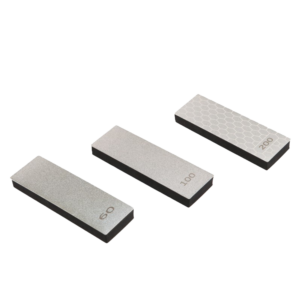
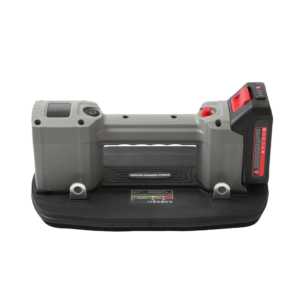
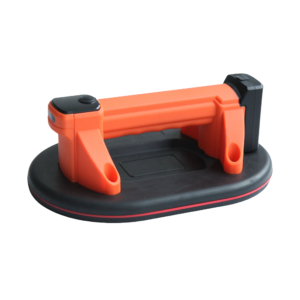
Complete your tiling kit with the High-Grade Manual Tile Cutter for thick and large-format tile, Diamond Hand Polishing Pad for edge finishing, and the 2-in-1 Tile Vibration Machine for setting the tiles you have cut.
Frequently Asked Questions
What is the difference between the Standard and High-grade GUSHI tile cutters?
The Standard model covers 600, 800 and 900 mm cutting lengths, tiles up to 14 mm thick, an 800 kg breaker and straight-cut accuracy within 1.5 mm. The High-grade model adds a 1200 mm length, capacity up to 18 mm, a 1000 kg breaker and accuracy within 1.0 mm on heavier rails. Both share the same aluminum base, double solid rails, anti-pinch handle and tungsten carbide wheel. Choose Standard for light-to-medium work and High-grade for daily professional use on thick or large-format tile.
Can the Standard cutter cut porcelain tile?
Yes, porcelain up to 14 mm thick cuts cleanly as long as the tungsten carbide wheel is sharp and you score in one continuous pass at even pressure. Porcelain is harder than ceramic and roughly halves wheel life, so expect 300 to 600 linear metres per wheel. For porcelain thicker than 14 mm, or for cutting it every day, the High-grade model is the better tool.
What tile sizes does each model handle?
The 600 mm model cuts 600 mm straight and 425 mm on the diagonal, the 800 mm model cuts 800 mm straight and 565 mm diagonally, and the 900 mm model cuts 900 mm straight and 635 mm diagonally. Diagonal capacity always equals the cutting length multiplied by 0.707, so size the machine for the diagonal cut you need, not just the straight one.
How accurate is the Standard model?
Straight cuts hold within 1.5 mm over the full cutting length when the rails are clean, the tile is seated flat and the wheel is sharp. That is well inside the tolerance needed for grouted floor and wall work. Accuracy degrades if the rails are dirty, the tile is warped, or the wheel has worn flat, so cleaning and wheel checks matter more than the machine’s rating.
Does it need electricity, water or dust extraction?
No. Scoring and snapping are entirely mechanical, so there is no motor, water tray or slurry. That makes the Standard cutter well suited to occupied homes, finished kitchens and upper-floor work where carrying water and running power is impractical. Cutting produces only fine dry debris, and eye protection is still required.
When should I upgrade to the High-grade model?
Upgrade when any of these apply: you cut tile most working days, you regularly handle material thicker than 14 mm, you work with tiles longer than 900 mm, or your jobs demand accuracy within 1.0 mm. If you cut a few times a month on standard 8 to 10 mm wall and floor tile, the Standard model does the same job for less money.
When should the scoring wheel be replaced?
Replace the wheel when the cut edge starts chipping, when the score line looks glassy rather than a fine white line, or when a second pass is needed to break the tile. Expect roughly 800 to 1,500 linear metres on ceramic and 300 to 600 metres on dense porcelain. Keep spare 22 x 6 x 6 mm wheels on hand so a worn wheel never stops a job.
What is the MOQ, warranty and delivery time?
The OEM MOQ is 100 units and mixed cutting lengths can be combined in one order. Every unit is inspected before shipment under ISO 9001:2015, and we remain responsible for the supplied product throughout its service life. Delivery is 5 to 10 days for standard orders and 15 to 30 days for customised OEM production, shipped from Shanghai or Ningbo.
OEM & Wholesale Information
| OEM / wholesale parameter | Details |
|---|---|
| MOQ | 100 units; mixed cutting lengths in one order |
| Customisation | Frame colour, logo printing, ruler scale and language, packaging artwork |
| Packing | 1 pc carton; 2 pcs/outer carton for 600 and 800 models |
| Spare parts programme | Scoring wheels, breaker feet, handles and side stops supplied with OEM orders |
| Sample policy | Samples at cost price plus freight; fee refunded on the official order |
| Payment terms | T/T, L/C, D/A, D/P, PayPal |
| Port of loading | Shanghai or Ningbo, China |
| Quality control | 100% inspection before shipment; ISO 9001:2015, CE, SGS |
| R&D support | In-house team for new sizes, handle tooling and packaging design |
| Service languages | English, Spanish, Japanese, Russian, French, German |
Huzhou Gu’s Imp. & Exp. Co., Ltd. (brands GUSHI Tools and Roycel) has manufactured and exported tile installation tools from Zhejiang since 2004, drawing on a supply chain built in this industry since 1998 and a production capacity of 100,000 sets per month. The company holds ISO 9001:2015 and CE certification, exports to more than 20 countries including the USA, Germany, the UK, the Netherlands, Brazil, Chile and Australia, and is one of the 23 Chinese exporters that won the US anti-dumping case on diamond blades at a 6.2% rate.
Continue through the range: GUSHI High-Grade Manual Tile Cutter, Silent Diamond Cutting Blade, and 6PCS Trowel Set.