Product Overview
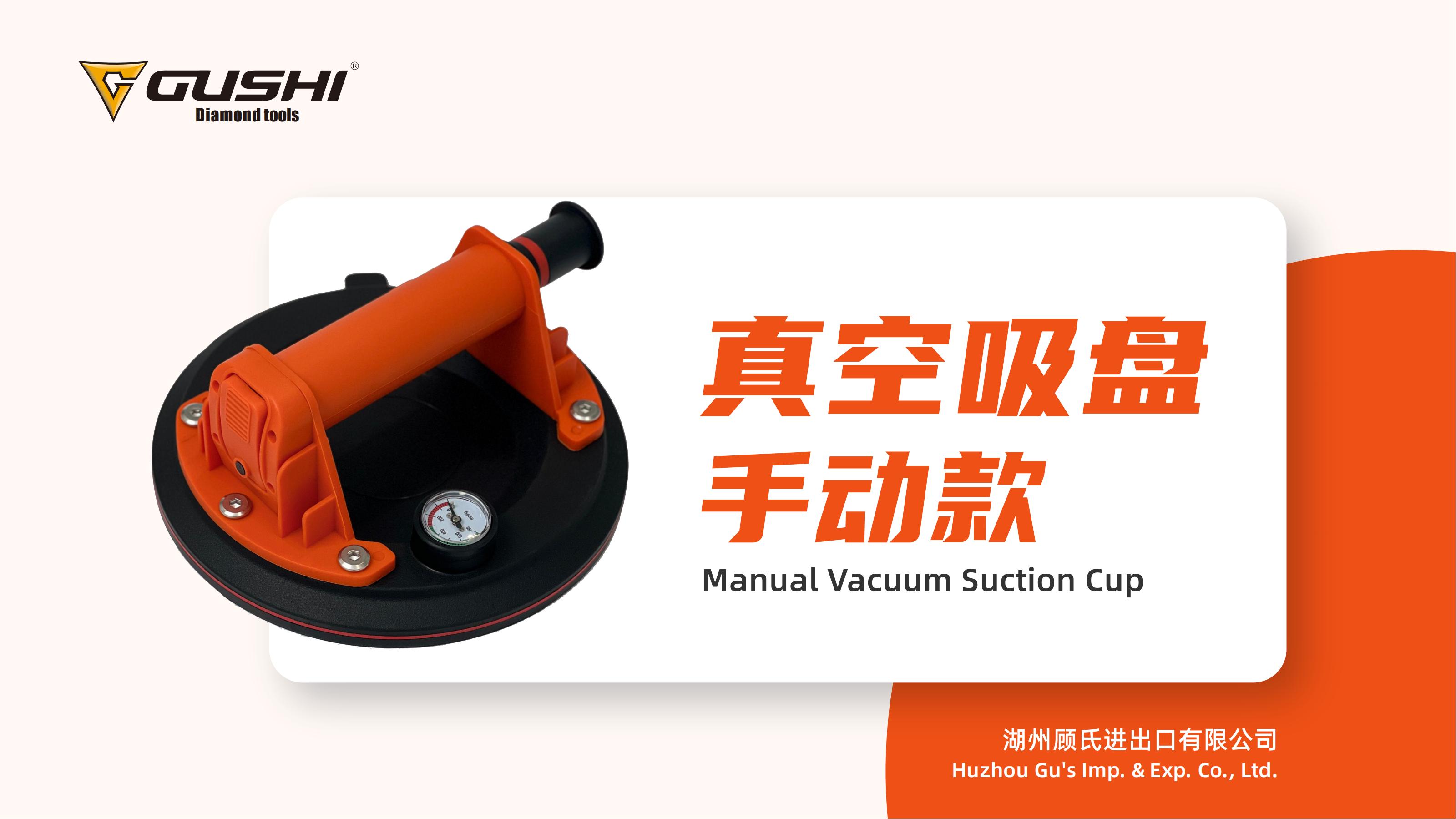

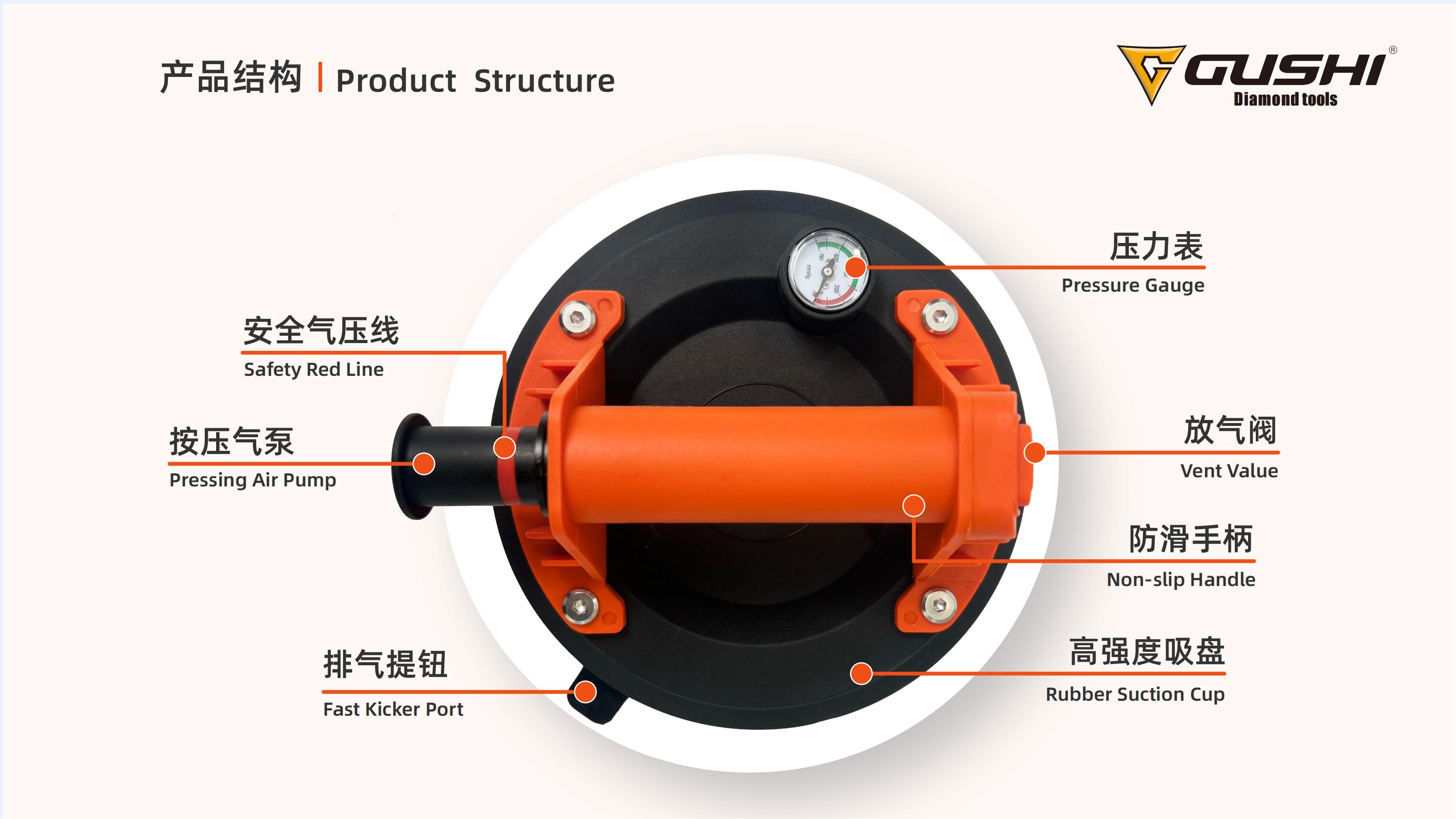



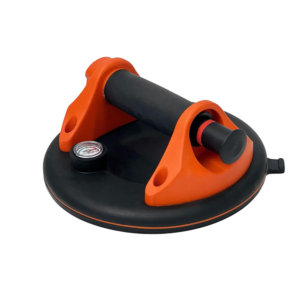
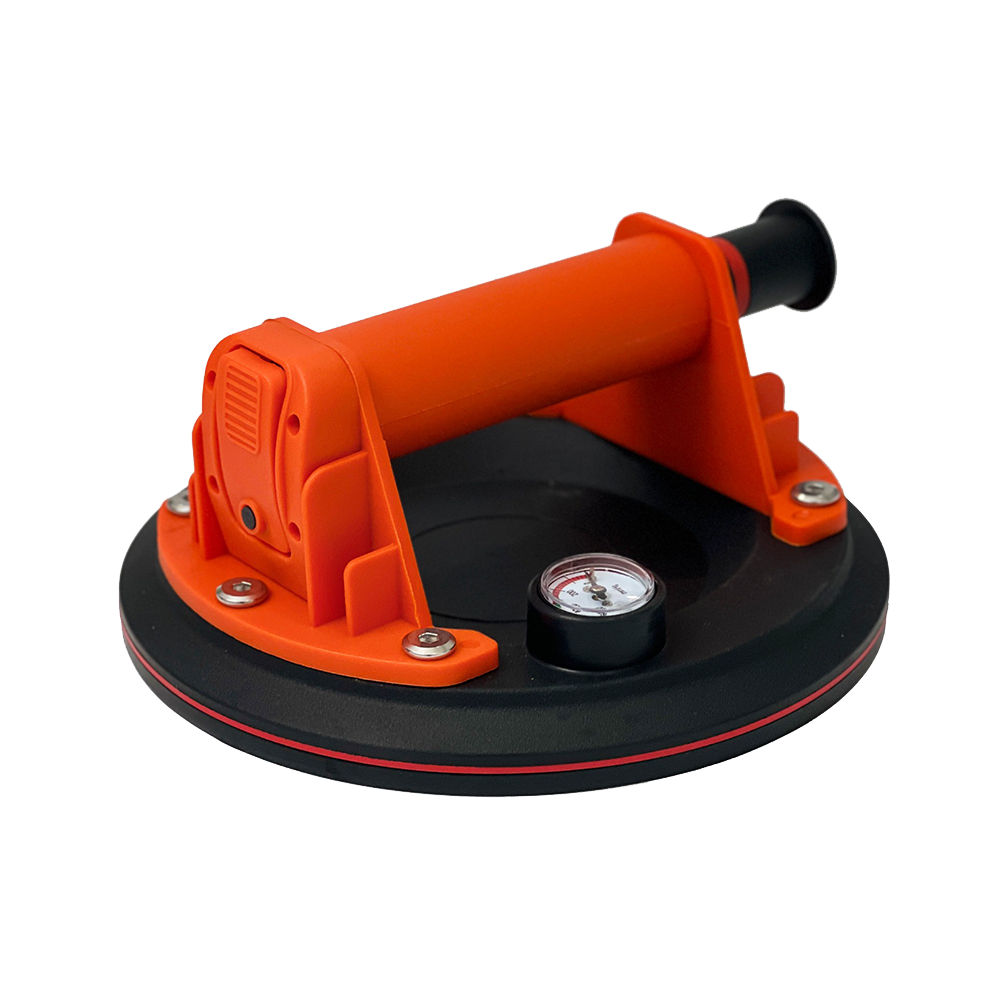
The GUSHI Manual Vacuum Suction Cup is a battery-free lifting tool that attaches to flat, clean, smooth and non-porous surfaces in 3–6 hand-pump strokes, then holds for over 6 hours. Available in 120 mm, 160 mm and 200 mm pad diameters, it delivers safe vertical working loads from 60 kg (132 lb) up to 150 kg (330 lb) for carrying glass panels, glazed tiles, sheet metal, stone slabs and appliances. It is manufactured by Huzhou Gu’s Imp. & Exp. Co., Ltd. (founded 2004, Zhejiang, China), an ISO 9001:2015 and CE certified factory that exports vacuum cups and tile installation tools to more than 20 countries with 100% QC inspection before shipment.
Unlike electric suction cups that depend on a charged battery or a compressed-air line, this manual cup uses a simple piston pump to evacuate the air under a high-grade rubber pad. Atmospheric pressure does the rest — no motor to fail, no battery to recharge, and no waiting for the tool to power up when a panel needs moving. That makes it the dependable choice for glaziers, tile setters, stone fabricators, auto-glass technicians and workshop crews who handle smooth panels in short, repeated lifts.
The range covers everyday handling and heavy panel work in one series. A Ø120 mm cup suits 60 kg loads such as large-format tiles and appliance shells; a Ø160 mm cup reaches the 100 kg (220 lb) class used for windshields and standard glass sheets; the Ø200 mm cup handles up to 150 kg for stone slabs and double-glazed units. Every configuration shares the same quick-release lever, optional red-line vacuum indicator, and non-marking pad that leaves no residue on glass or painted surfaces.
Full Specifications
| Parameter | Specification |
|---|---|
| Product name | Manual Vacuum Suction Cup (hand-held vacuum lifter) |
| Model | SC-A001 series (SC-A001 / SC-A002) |
| Type | Manual piston-pump vacuum cup — no battery or power required |
| Available pad diameters | Ø120 mm (4.7 in) / Ø160 mm (6.3 in) / Ø200 mm (8 in) |
| Safe vertical working load — Ø120 mm | 60 kg (132 lb) |
| Safe vertical working load — Ø160 mm | 100 kg (220 lb) |
| Safe vertical working load — Ø200 mm | 150 kg (330 lb) |
| Max horizontal (shear) load — Ø200 mm | Up to 200 kg (440 lb) |
| Theoretical pull-off force — Ø200 mm | ≈2,800 N at 90 kPa differential pressure |
| Pump strokes to full seal — Ø120 mm | 3–6 strokes |
| Holding time | >6 hours; re-pump without detaching via check valve |
| Pad material | Non-marking natural rubber (NR) compound, Shore A 55–65 |
| Handle & body material | Die-cast aluminum alloy / reinforced ABS |
| Release mechanism | Quick-release lever + side release valve |
| Vacuum indicator | Red-line indicator (Ø160 mm & Ø200 mm configurations) |
| Operating temperature | -10 °C to +50 °C (warm the pad when below 0 °C) |
| Suitable surface | Flat, smooth, clean, non-porous |
| Net weight — Ø120 mm | ≈0.9 kg (1.98 lb) |
| Dimensions — Ø120 mm | Ø120 × H115 mm |
| Packing | Color box; 10 pcs/inner box, 100 pcs/outer carton (custom available) |
| Certifications | ISO 9001:2015, CE, RoHS-compliant materials, SGS inspected |
| MOQ | 500 pcs (mixed sizes in one order) |
| Lead time | 5–10 days (stock); 15–30 days (OEM) |
| Payment terms | T/T, L/C, D/A, D/P, PayPal |
| OEM services | Custom pad diameter, handle color, logo, blister/card packaging |
How the Manual Vacuum Suction Cup Works
Creating the vacuum with the hand pump
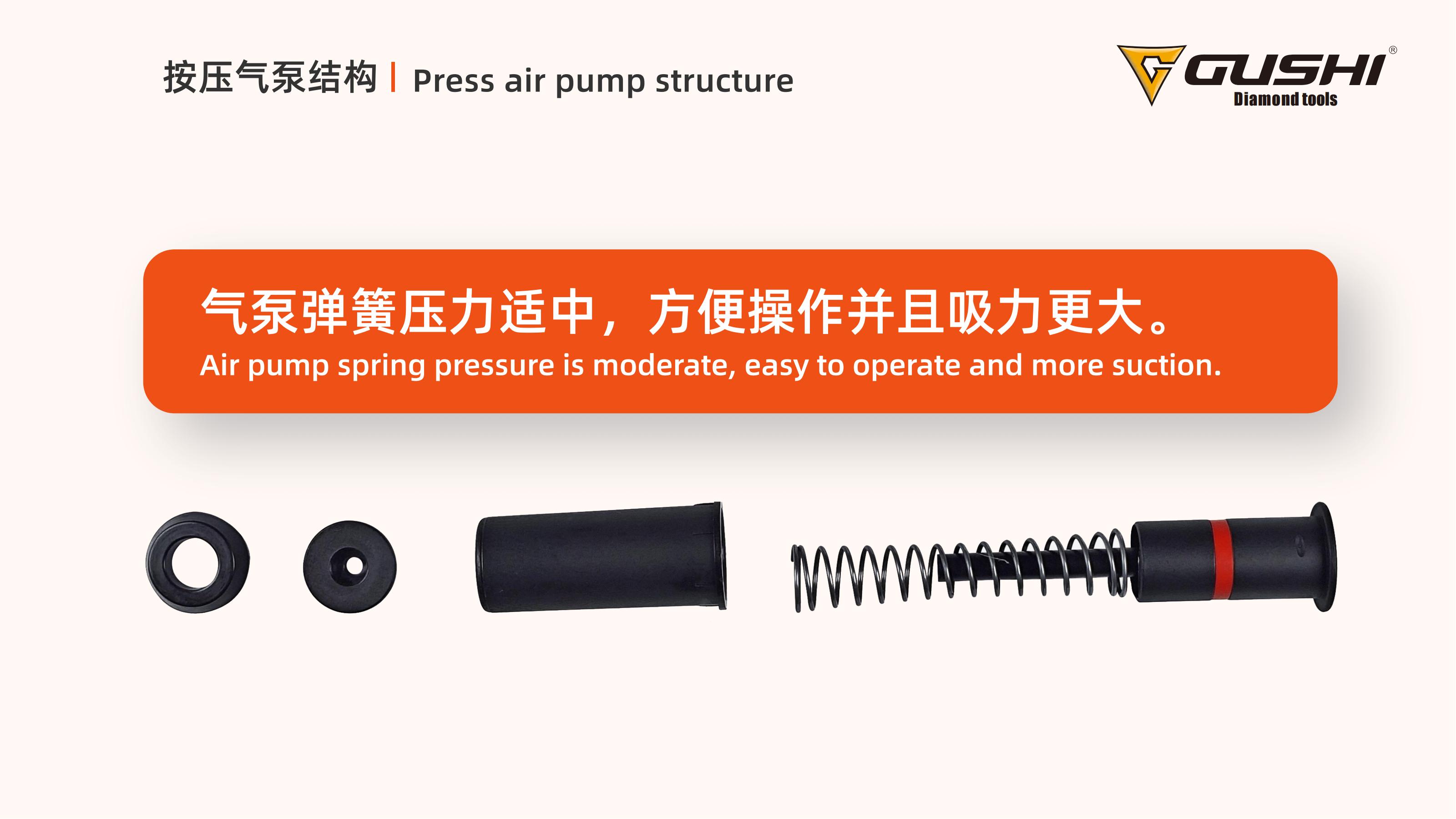
The cup relies on a sealed chamber formed between the rubber pad and the load surface. Each stroke of the piston pump pushes air out through a one-way check valve, lowering the pressure inside the chamber. On a Ø120 mm cup, three to six strokes are enough to reach the working vacuum; larger pads take a few more. Because the valve only lets air out, the vacuum is held even if you pause mid-pump.
Why atmospheric pressure does the lifting
Once the internal pressure drops, the higher atmospheric pressure outside presses the pad onto the surface. The holding force equals pad area × pressure difference: a Ø200 mm pad has about 314 cm² of area, so a 90 kPa differential generates roughly 2,800 N (≈285 kg) of theoretical pull-off force. Rated safe working loads apply a safety factor of about 2:1 over the theoretical figure — this is why the Ø200 mm cup is rated at 150 kg vertical rather than at its physical maximum.
Releasing with the quick-release lever
To detach, pull the release lever or press the side release valve. This opens the chamber to atmosphere, equalizing pressure instantly so the pad lifts off cleanly with no tugging or damage to the material edge. The same release action makes repositioning fast: lift slightly, slide the cup to the new position, and re-pump — the whole cycle takes a few seconds.
Key Features Explained
Battery-free hand-pump operation
With no motor, battery or air compressor, the manual vacuum cup is always at working pressure the moment you pick it up. It never needs charging overnight, never fails on a job site without power, and has almost nothing to wear out beyond the pad itself — a decisive advantage for glaziers and installers who work on scaffolding and in finished interiors.
High-grade non-marking rubber pad with multi-lip seal
The Shore A 55–65 natural rubber compound flexes to follow slight surface curvature while its sealing lip maintains the vacuum. The pad is formulated non-marking, so it leaves no stains or residue on glass, mirrors, polished granite or painted metal — important when handling customer-ready panels and windshields.
Quick-release lever with one-hand control
The ergonomic handle lets you carry with one hand while the release lever and side valve are positioned for thumb operation. This matters on ladders and scaffolding, where you need to attach, reposition and release panels without setting down the load or reaching for a second tool.
Red-line vacuum indicator and check valve (Ø160/Ø200 mm)
The indicator shows at a glance whether enough vacuum remains to lift safely. If the red line appears during a long task, the check valve lets you re-pump to full vacuum without detaching the cup — so a slow air leak on a slightly imperfect surface never turns into a dropped panel.
Multi-size series and OEM flexibility
One product family covers 60–150 kg working loads through three pad diameters, simplifying inventory. For distributors and tool brands, we customize pad diameter, handle color, logo and retail packaging at an MOQ of 500 pieces, with mixed sizes accepted in a single order.
Selection Guide: Which Cup Size Do You Need?
Match the pad diameter to the heaviest panel your crew handles. Use two cups for large, fragile sheets so the load is shared and the panel is kept flat.
| Pad diameter | Safe vertical working load | Typical panel size handled | Best application |
|---|---|---|---|
| Ø120 mm (4.7 in) | 60 kg / 132 lb | Up to ~600 × 600 mm tile; single-hand items | Large-format tiles, appliance shells, plastics |
| Ø160 mm (6.3 in) | 100 kg / 220 lb | Single glass sheets up to ~3 m² | Windshields, mirrors, furniture panels |
| Ø200 mm (8 in) | 150 kg / 330 lb | Stone slabs and double-glazed units | Granite/marble slabs, slate, heavy equipment |
Applications & Suitable Materials
Applications
| Application | Why the vacuum cup fits | Recommended configuration |
|---|---|---|
| Auto glass & windshield handling | Holds curved and flat glass without metal clamps touching the edges | Ø160 mm or two cups |
| Window, mirror & glass door installation | Clean, mark-free grip for positioning panels into frames | Ø160–200 mm |
| Ceramic & porcelain tile carrying | Fast pickup and placement of large-format tiles on floors and walls | Ø120–160 mm |
| Stone slab & slate handling | Carries polished granite, marble and slate sheets without edge chipping | Ø200 mm or two cups |
| Sheet metal & appliances | Lifts and repositions steel, fridges, washing machines in tight spaces | Ø160 mm |
| Aquariums & glass furniture | Maneuvers assembled glass tanks and tabletops safely | Ø160 mm |
| Plastic & acrylic sheets | Non-marking pad avoids scratching polished plastic surfaces | Ø120 mm |
| Engine valves & machine parts | Lifts smooth metal components for cleaning, inspection and assembly | Ø120 mm |
Suitable Materials
| Suitable (flat, smooth, non-porous) | Not suitable (porous, textured or dirty) |
|---|---|
| Float glass, tempered glass, laminated glass | Raw concrete, brick and masonry |
| Glazed ceramic and porcelain tiles | Textured or flamed stone surfaces |
| Polished granite, marble, slate | Raw wood, plywood and wood-grain laminates |
| Stainless steel, painted sheet metal | Curved surfaces beyond pad flexibility |
| Acrylic, polycarbonate, ABS sheets | Wet, oily, dusty or greasy surfaces |
| Finished appliance panels | Cardboard and perforated panels |
Manual vs. Electric Vacuum Suction Cup: Which Should You Buy?
GUSHI makes both types — this manual SC-A001 series and the electric SC-B series. The table below compares them across the criteria that matter most to buying teams.
| Dimension | Manual Vacuum Suction Cup (SC-A001) | Electric Vacuum Suction Cup (SC-B series) |
|---|---|---|
| Power source | ✓ None — hand pump only | 12V lithium battery / mains adapter |
| Weight & portability | ✓ ≈0.9–1.2 kg, pocket-portable | 1.5–2.5 kg with battery pack |
| Time to attach | 3–6 pump strokes (5–10 s) | ✓ One-button pump (≈2 s) |
| Continuous all-day handling | Manual effort per lift — best for intermittent use | ✓ One-touch cycle, less operator fatigue |
| Lifting capacity | 60–150 kg by pad size | Same range — capacity follows pad Ø |
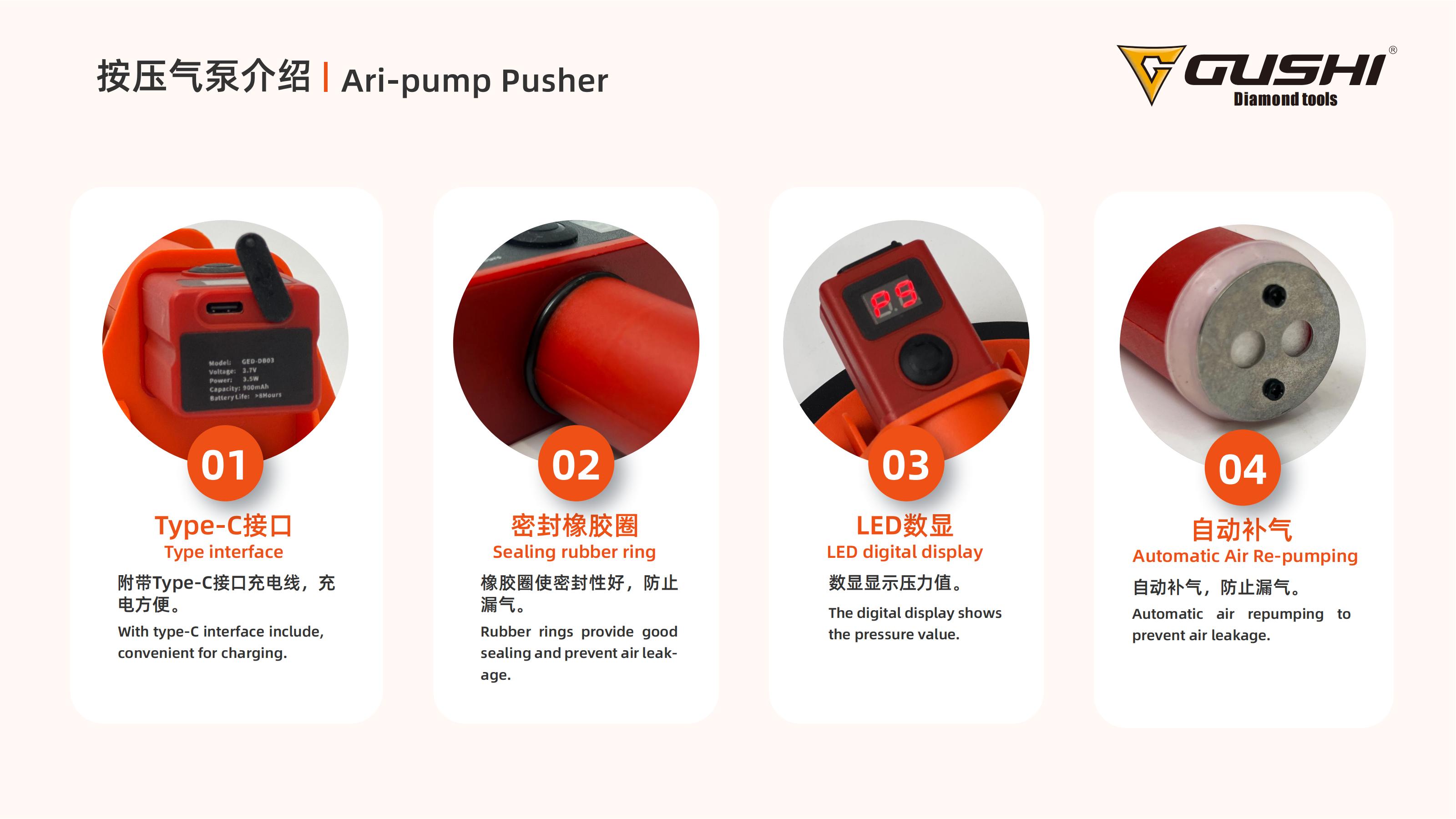
| Vacuum status display | Red-line indicator (Ø160/200 mm) | ✓ Digital display with vacuum value |
| Dependency on power | ✓ None — works anywhere | Needs charged battery or outlet |
| Failure points | ✓ Fewer — pad and valve only | Motor, battery cells, electronics |
| Initial cost per unit | ✓ Lower (approx. 1/3–1/2 of electric) | Higher |
| Maintenance | ✓ Pad cleaning, no electronics | Battery replacement and charger care |
| Best for | No-power sites, intermittent lifting, budget buying, spare tool | High-volume glazing/tile crews, long shifts |
Bottom line: Buy the manual cup when you need a reliable, low-cost lifter for occasional panel work anywhere on site. Choose the electric model when your crew attaches and releases cups hundreds of times per day and the extra speed pays for the higher price. For most distributors, stocking both covers every customer.
How to Use: Step-by-Step Guide
- Inspect the rubber pad for cuts, embedded debris or wear before each task; replace a damaged pad immediately.
- Clean the load surface — it must be flat, smooth, non-porous and free of oil, water, dust and release agents.
- Wipe the pad with a clean, dry cloth; moisture or grease on the pad sharply reduces grip.
- Check the panel weight against the rating: Ø120 mm → ≤60 kg, Ø160 mm → ≤100 kg, Ø200 mm → ≤150 kg vertical.
- Place the cup flat on the surface at a balanced position — near the panel’s center of gravity for one cup, top corners for two.
- Pump the piston 3–6 times (or until firm resistance) to draw the vacuum; never force the pump past resistance.
- Confirm the vacuum: the red-line indicator must show full suction on Ø160/Ø200 mm models before lifting.
- Do a test lift of 5 cm and pause; if the cup slips or the indicator drops, re-pump or reposition and test again.
- Lift smoothly with the handle; use two hands for loads over 25 kg and keep the panel vertical when walking.
- Carry at a safe height, clear of obstacles and other workers; never swing or throw the load.
- To release, set the load down firmly, then pull the release lever or press the side valve and lift the cup off cleanly.
- Re-check suction every 30 minutes during long positioning jobs, re-pumping as needed via the check valve.
Pair this lifter with the rest of your panel-handling and installation kit: see our Electric Vacuum Suction Cup, 2-in-1 Tile Vibration Machine, and G-Ultra Lifter.
Frequently Asked Questions
What is a manual vacuum suction cup and how does it work?
A manual vacuum suction cup is a battery-free lifting tool that uses a hand pump or lever to evacuate air between a rubber pad and a smooth surface. Atmospheric pressure then presses the pad against the material, creating a hold strong enough to lift panels. A release valve breaks the vacuum for instant detachment. No electricity or compressed air is needed.
How much weight can the GUSHI manual vacuum suction cup lift?
Safe vertical working loads are 60 kg (132 lb) for the 120 mm pad, 100 kg (220 lb) for the 160 mm pad, and 150 kg (330 lb) for the 200 mm pad on clean, flat, non-porous surfaces. Horizontal (shear) loads can be up to about 200 kg. Always perform a lift test and keep a safety margin of at least 2:1 over the panel weight.
What surfaces can the vacuum cup attach to?
The cup grips flat, smooth, clean and non-porous surfaces: float and tempered glass, glazed ceramic and porcelain tiles, polished granite and marble, stainless steel and painted sheet metal, acrylic and polycarbonate sheets, slate and finished appliances. It will not hold on textured stone, raw wood, concrete, cardboard or wet or oily surfaces.
How long does the suction hold and can it be re-pumped?
A properly sealed cup holds for more than 6 hours at room temperature. The built-in check valve lets you re-pump without detaching the cup when the red-line indicator shows vacuum loss. Re-check suction every 30 minutes during long positioning tasks, as air can slowly leak past the seal on slightly imperfect surfaces.
Manual or electric vacuum suction cup — which should I choose?
Choose the manual cup for intermittent lifting, no-power job sites, light weight (about 0.9 kg) and lowest cost. Choose an electric vacuum suction cup (like the GUSHI SC-B series with digital display) when you lift panels continuously all day and want one-button attachment. Lifting capacity is similar because both depend on pad diameter and vacuum level.
Is it safe to lift glass windshields and panels with this cup?
Yes, when used correctly: clean both the pad and the glass, pump until the indicator confirms full vacuum, lift with two hands for panels over 25 kg, and never suspend a load overhead or carry it over people. The non-marking rubber pad leaves no residue on glass, mirrors or painted metal.
What is the MOQ and can I get OEM branding?
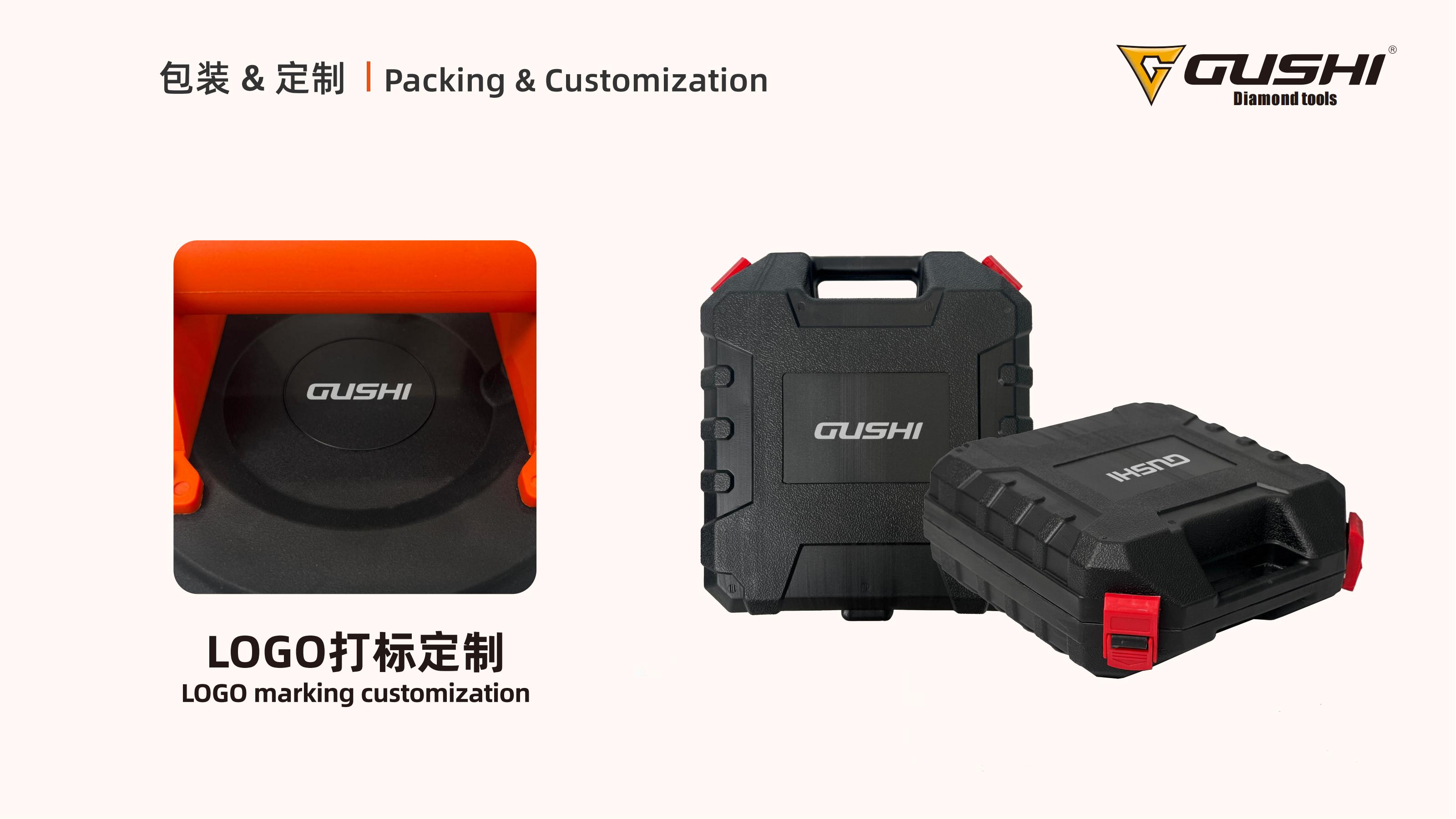
The OEM MOQ is 500 pieces, and mixed pad diameters can be combined in one order. We offer custom pad diameter, handle color, laser-engraved or printed logo, blister and color-box packaging, and private-label cartons. Samples are available at cost price with the sample fee refunded on the first official order.
Are you a manufacturer and what certifications do you hold?
Huzhou Gu’s Imp. & Exp. Co., Ltd. is a Zhejiang-based manufacturer founded in 2004, with a supply chain in this industry since 1998. We hold ISO 9001:2015, CE and RoHS compliance with SGS product inspection, run 100% QC before shipment, and export to 20+ countries. Standard delivery is 5–10 days; custom orders take 15–30 days.
OEM & Wholesale Information
| OEM / Wholesale parameter | Details |
|---|---|
| MOQ | 500 pcs (mixed pad sizes in one order) |
| Customization | Pad diameter, handle color, logo printing/engraving, blister & color-box packaging, carton labeling |
| Sample policy | Samples at cost price + shipping; sample fee refunded on first official order |
| Payment terms | T/T, L/C, D/A, D/P, PayPal |
| Port of loading | Shanghai or Ningbo, China |
| Production capacity | Factory output of 100,000 sets/month across the GUSHI tool range |
| Quality control | 100% inspection before shipping; ISO 9001:2015, CE, SGS |
| After-sales | Responsible for the supplied product within its usage life |
| Languages | English, Spanish, Japanese, Russian, French, German |
Huzhou Gu’s Imp. & Exp. Co., Ltd. (brands GUSHI Tools and Roycel) has manufactured and exported handling and installation tools from Zhejiang, China since 2004, building on a supply chain active in this industry since 1998. Customers in more than 20 countries — including the USA, Germany, the UK, the Netherlands, Brazil, Chile and Australia — buy from us under their own brands through OEM/ODM programs. Many have worked with us for over 10 years, relying on consistent quality, R&D support and dependable 5–10 day dispatch on stock items.
Explore our complete panel-handling range: Electric Vacuum Suction Cup with Battery, G-Ultra Lifter, and 2-in-1 Tile Vibration Machine.